Showing posts with label General Chemistry. Show all posts

Monday, January 14, 2013

Pharaoh's Serpent Experiment

Pharaoh's Serpent Experiment is a Mercury (II) Thiocyanate decomposition reaction. 

Explanation and Reactions:
 http://www.chem-toddler.com/redox-reactions/pharaohs-snakes.html

Monday, November 26, 2012

Molecular Shape and Molecular Orbitals

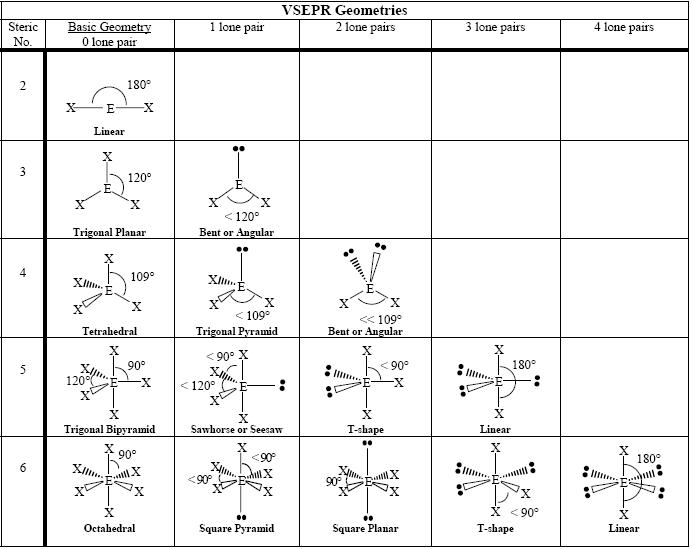
VSEPR Model or Valance Shell Electron Pair Repulsion Model is an important concept to determine the shape of the molecules. There are several common shapes of molecules that we have to concern:
VSEPR Geometric Shape and Angle
Source: http://chemistry.ncssm.edu/labs/molgeom/index.html
Molecular Orbitals 

To determine the existence of the molecules, we consider the actual overlapping between molecules or between atoms
Some Rules are important in order to get the correct orbital population

  1. Always fill the electrons up in the lowest energy orbital 
  2. 2 electrons are maximum in each orbital, and two electrons are represented by two antiparallel arrows  
We only focus on the atoms in periodic 1 and 2 in this level: 
Anti-bonding orbitals always have star superscript 
Bonding orbitals always have the lower energy level than Anti-bonding 
General Orbital Diagram for Period 2 Elements
Source: http://universe-review.ca/F12-molecule.htm

This is the diagram only apply for O,F, Ne. Notice that the 2p bonding orbitals have a different arrangement from the anti-bonding orbital. 
Orbital Diagram for O,F, and Ne
Source: http://bobcatchemistry.wikispaces.com/AP+Chem+Lab+7

Bond Order and Bond Length 
The orbitals can help us to predict the stability of the molecules by the Bond Order 
Bond Order Formula


The number of bond order represents the molecules have single, double, triple bonds (or different fractions based on the molecules)

Moreover, with bond order, we can determine the bond length between the molecules: 
the higher the e cell, the more easily reduced


Source: Lectured by Professor Eric Bullock 

Saturday, November 24, 2012

Quantum Mechanics

QUANTUM NUMBERS OF ELECTRONS OF ATOMS
There are four quantum numbers describe the location of electrons
The Principle Quantum Number: (n)
It represents the shell of orbitals in the atom, n is any integers (1,2,3,4,5,...)
The Second Quantum Number: (l) 
l=n-1
It describes the shape of the orbitals
s orbitals: spherical
p orbitals: dumbbell-shaped
The Third Quantum Number: (ml)
-l <ml <l
It represents the orientation of the e-pair in space.
ml=-3,-2,-1,0,1,2,3 or -2, -1, 0, 1 , 2 (Depends on the element)

The Fourth Quantum Number: (ms)
It represents the spinning direction of the electrons
ms=1/2 or -1/2 only

Example: 
Question: What are the quantum numbers of the Element with Atomic number 31?
Answer: From periodic table, we know that Galium (Ga) has Atomic Number= 31 and the electron configuration (EC) is 1s22s22p63s23p63d104s24p1
From the EC, we can see Ga has 4 orbitals of electrons: n=4 
The outer layer of Ga is p so l=1
The outer layer is p which has 3 orbitals: ml= -1, 0, 1
Since there is only 1 electron in the outer layer, it must be spinning up so ms=1/2

Saturday, November 17, 2012

Electrochemistry

TERMINOLOGY 
Electrode is an electrical conductor that uses to contact with nonmetal part in the circuit 
Electrolyte is a compound that conducts electricity in solution 
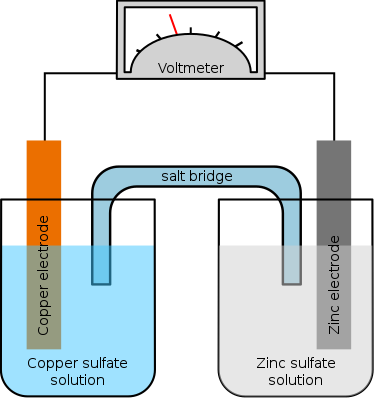
Salt Bridge is a tube that contains salt solution (Any kind of salt, KNO3 is common). It connects the Anode and Cathode 
Reduction is the process of GAINING electron(s). Reduced agent is the atom or ion that LOSE electron(s)
Oxidation is the process of LOSING electron(s). Oxidized agent is the ion that GAIN electron(s)

Cathode is an electrode, has a positive charge where Reduction occurs

Anode is an electrode, has a negative charge where Oxidation occurs

MNEMONIC DEVICE: 
 LEO: GER 
(Lion growls)
 (Losing Electron- Oxidation) : (Gaining Electron- Reduction)
CPR : ANO
(Cathode, Positive, Reduction) : (Anode, Negative, Oxidation)

STANDARD CELL NOTATION 
            
              Anode Electrode I Anode Electrolyte II Cathode Electrolyte I Cathode Electrode 

Example: 


Cu-Zn Galvanic Cell
Source: http://en.wikipedia.org/wiki/Galvanic_cell

The Redox Reaction for this Cell:
Zn(s) + Cu2+ (aq)à Zn2+ (aq) +Cu (s)
Half Life Reaction
                       Zn(s)   à Zn2+ (aq) + 2e        Oxidation (Anode)
            Cu2+ (aq) + 2e à Cu (s)                 Reduction (Cathode)
Standard Cell Notation
Zn(s) I Zn2+ (aq) II Cu2+ (aq) I Cu (s) 


REDUCTION POTENTIAL
EoCELL = Eo REDUCTION – Eo OXIDATION
To Calculate the EoCELL, we need to look up the Reduction Potential energy from the table 
Standard Reduction Potentials Table
Source: http://www.jesuitnola.org/upload/clark/refs/red_pot.htm


IMPORTANT: DO NOT flip the sign of Eo when calculating. Keep the same sign as given in the table. 
TRICK: The LARGER the Eo, the easier to become REDUCTION

ΔGo AND  EoCELL 

To determine the reaction is spontaneous or not, we can use the following equation:
Equation  (1)
NOTE: the equation is using a new constant  F = 9.65x10⁴ (J/Vmol) or (Coulomb/mol)  and n IS NOT the mole of solutions but the NUMBER OF MOLES OF ELECTRONS TRANSFERRED in the reaction

From the formula we can conclude that:
 IF EoCELL is NEGATIVE, the reaction is NONSPONTANEOUS
 IF EoCELL is POSITVE, the reaction is SPONTANEOUS

CELL POTENTIAL AND CONCENTRATION 
When the concentration change, the cell will also be affected because of the K or Q constant of the reactions. 

The following equation will help us to calculate the new potential when the concentrations of solution are changed or find concentrations with given Cell potential
Use only when the reaction is at standard condition 

Use only when the reaction is not at standard condition 
Nernst Equation
Since R,T, and  F are constant, we can convert the ln to log and combine all the constant together to and a simple equation: 
Simplified Form
COULOMBS AND AMPERES IN CURRENT

C= A x t 
C: Coulomb
A: Ampere 
t: second 
Note 1C= 1As

Source: Lectured by Professor Eric Bullock 

Sunday, November 4, 2012

Thermodynamics

First Law of Thermodynamics
Energy is neither created nor destroyed
Energy and Work Formula


Second Law of Thermodynamics 
Whenever a spontaneous occurs, it will causes an increase in entropy of universe

Third Law of Thermodynamics 
At absolute zero (0 K),  the entropy of solid and crystal are at  0

Saturday, September 29, 2012

Acid and Base Definitions

Acid and Base are two important substances in Chemistry. Commonly, acid is classified as sour substances and base is bitter. Three scientists have defined acid and base and which improved the knowledge in Chemistry

  • Arrhenius Definition 
Acid: Anything produces Hydrogen Ion (H+) and dissolve in water 
Base: Anything produces Hydroxide Ion (OH-) and dissolve in water
Note: Dissociation is different from Solubility, for instance, Calcium Hydroxide is strong base, dissociate completely but slightly soluble. 
  • Brønsted–Lowry Definition 
Acid: Anything donates proton H+ to others
Base: Anything accepts proton H+ from others 

Acid and Base strength
Stronger Brønsted acid. Weaker conjugate base
Weaker Brønsted acid. Stronger conjugate base

For equilibrium reaction in weak acid and base 
All acid base reaction favor weak acid and weak base which means the reaction will shift toward the side of weaker acid or base. 

Important Terminology
Amphoterism: species of molecule or ion that can act as acid and base
Amphoprotic molecule: is the molecule that can donate and accept proton

Periodic Trends 

The strength of binary acid (H-X) 
The weaker the bond is, the stronger the acid is
The more electronegativity X is, the more polar the bond and the stronger the acid  
The more polar the H-X bond is, the stronger acid is.
The larger the atom is, the stronger the acid is. 

Figure 1a. Binary Acid Trends

The strength of Oxoacid (H-O-Y)
The greater the electronegativity of Y is, the stronger the acid is. 
(The more Oxygen in Y is, the more electronegavity is) 

Figure 1b. Oxoacid Trends
  • Lewis Definition
Acid: Any ion or molecule that can accept a pair of electrons in order to form a covalent bond.
Base: Any ion or molecule that can donate a pair of electrons in order to form a covelent bond.


MNEMONIC DEVICE: 
Arrhenius vs. Ions, 
Brønsted vs.Protons
Lewis vs. Electron pairs (Shape)  
Source:
Jespersen, Neil D. Chemistry The Molecular Nature of Matter. John Wiley & Sons. Inc. 2011. 
        (740- 766). Print


Sunday, September 16, 2012

Redox Reaction Balance Method

Ion-Electron Method in Acid Solution
1)  Identify the oxidation numbers of all oxidants and reductants
2)  Identify the Oxidants and Reductants
3) Write down the half reactions
4) Balance atoms other than H and O
5) Add H2O to balance O and Add H+ to balance H
6) Balance the number of electron on the half reactions by taking common factor
7) Add up the half reactions
8) Combine and Cancel similar terms
9) Check balance on atom and charges

Example 
Balance MnO4- + H2SO3--> SO42- + Mn2+
1) Oxidation # MnO4- = +7, S in H2SO3 = +4, S in SO42- = +6, Mn2+ = +2
2) Oxidant: MnO4- and Reductant  H2SO3 +
3)  MnO4- +5e -->  Mn2+
            H2SO3 --> SO42- +2e
4) No need to balance other atoms in this case
5) 8H+ + MnO4- +5e -->  Mn2+ + 4H2O
           H2O +  H2SO3 --> SO42- +2e + 4H+
6) (8H+ + MnO4- +5e -->  Mn2+ + 4H2O) x2
           (H2O +  H2SO3 --> SO42- +2e + 4H+) x5
7) 16H+ + 2MnO4- +10e +5H2O +5H2SO3 --> 2Mn2+ + 8H2O + 5SO42- + 10e +20H+
(Cancel and Combine Highlighted similar terms)
8) 2MnO4- +5H2SO3 --> 2Mn2+ + 3H2O + 5SO42- + 4H+
9) Left hand side: 2Mn. 23O, 10H , net charge=-2
    Right hand side: 2Mn. 23O, 10H, net charge= +4 -10 +4= -2

Ion-Electron Method in Basic Solution
1)-9) the same as Acid Solution
10) Add OH- on both sides base on the H+ amount
11) Combine H+ and OH- into water/ Combine water molecule if possible
Example
Using same balanced equation
10) 4OH-+ 2MnO4- +5H2SO3 --> 2Mn2+ + 3H2O + 5SO42- + 4H+ + 4OH-
11) 4OH-+ 2MnO4- +5H2SO3 --> 2Mn2+ + 3H2O + 5SO42- + 4H2O (Combine water molecules)
       => 4OH-+ 2MnO4- +5H2SO3 --> 2Mn2+ + 7H2O + 5SO42-

Sunday, August 19, 2012

Aqua Regia

Introduction


Theoretically, Gold and Platinum are noble metals, which hardly reacts with acid or base solution, however, scientists  developed a solution of nitric acid and hydrochloric acid with 1:3 volume ratio (HNO3+ 3HCl). This solution is called Nitric acid hydrochloride or Aqua Regia in common.

Reaction: Au + HNO3 + 3HCl --> AuCl3 + NO+ 2H2O

Chemistry Useful Formula (For General and AP)

http://www.chemistrygeek.com/2004eqtable.PDF

Friday, July 13, 2012

Common Chemicals Abbreviation

ATP= Adenosine Triphosphate
ADP= Adenosine Diphosphate
AMP= Adenosine Monophosphate
DDT= Dichlorodiphenyltrichloroethane
NADP+ = Niicotinamide Adenine Dinucleotide Phosphate
Chll-= Chlorophyll
PVC= Polyvinyl Chloride
VOC=  Volatile Organic Compounds
PE= Polyethylene 
IPTG= Isopropylthio-Beta-Galactoside
ONPG= o-nitrophenyl-Beta-Galactoside
TNT= Trinitrotoluene


Friday, June 22, 2012

Periodic Table Information and Trends

Periodic Table
Source: http://www.ptable.com/
Trends:
Atom sizes, Ion sizes, and Radius increase from TOP to BOTTOM and RIGHT to LEFT
Electronegativity, Ionization energy increase from BOTTOM to TOP and LEFT to RIGHT

IMPORTANT: The highest electronegativiy element is FLUORINE

Friday, June 15, 2012

Ions Naming rules

The basic concepts in learning Chemistry is to memorize the name and the charges of ions.  As we know, there are many ions, sometime we could mess up with the ending of those ions, such as -ate, -ite, -ide, etc. and the charges. Personally I have my mnemonic device to handle them. To memorize those ions, we need to know the basic naming rule and separate them into groups

  • The CARBON-Contain group 


  • The SULFUR-Contain group 


  • The HALOGEN-Contain group

  • The PHOSPHORUS and NITROGEN-Contain group 


  • The HYDROGEN-Contain group 


  • The CHROMIUM and MANGANESE- Contain group